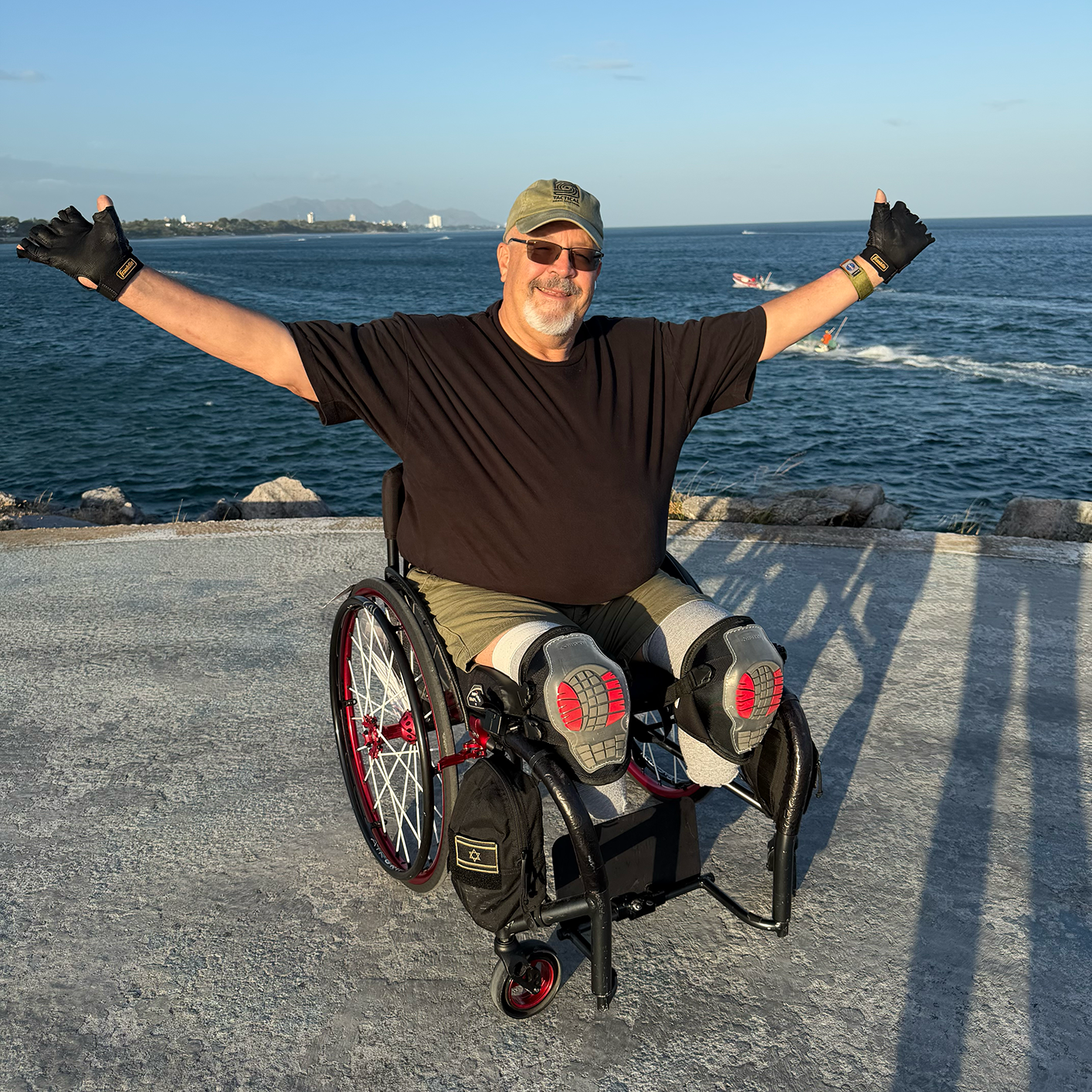
April is Limb Loss and Limb Difference Awareness Month. For many people, it is a time to learn, to listen, and to recognize a community that is far larger and more diverse than most people realize. For me, it is also a time to pause and reflect on my own journey.
I am a multiple amputee. Both of my legs have been amputated below the knee. I have significant amputations on both hands, with multiple fingers missing and both thumbs affected. I use a wheelchair. Those are the facts. They are part of my story, but they are not the whole story.
My life is not defined by what is missing. It is shaped by what remains, what I have rebuilt, what I have discovered, and what I continue to pursue. Limb loss changed nearly every practical detail of my life, but it did not take away my purpose, my humor, my curiosity, my love for my family, my desire to help others, or my determination to live fully.
This month matters because limb loss is often misunderstood. People sometimes see an amputee and immediately think of tragedy, limitation, dependence, or loss. And yes, there is loss. There is grief. There are things that are hard, frustrating, exhausting, and deeply personal. I do not want to minimize any of that. Becoming an amputee is not simply a matter of “staying positive” or “overcoming adversity” with a smile. It is much more complicated than that.
But it is also not the end of a meaningful life.
For me, becoming an amputee was not the closing chapter of my story. It was the beginning of a different chapter, one I never would have chosen, but one I have learned to live with, grow through, and even thrive in.
Becoming an Amputee
There are moments in life when everything changes. Some are joyful. Some are devastating. Some are so big that they divide your life into “before” and “after.”
Becoming an amputee was one of those moments for me.
There was the physical reality, of course. The surgeries. The healing. The pain. The medical equipment. The learning curve. The first time looking at my body and realizing that it would never be the same. There were practical questions that came at me all at once: How will I get around? How will I work? How will I drive? How will I dress, cook, travel, open a door, pick up small objects, or do the things I used to do without thinking?
But there were deeper questions too. Who am I now? How will others see me? Will I still be able to be the husband, father, friend, storm chaser, builder, problem solver, and person I have always tried to be? Will my life shrink, or can it still expand?
Those questions do not get answered in one day. They get answered slowly, in thousands of ordinary moments. They get answered when you figure out how to transfer from one place to another without help. They get answered when you drop something for the tenth time and still find a way to pick it up. They get answered when you go out in public and feel the stares, but keep going anyway. They get answered when you decide that your body has changed, but your life still belongs to you.
There is grief in limb loss. I believe it is important to say that plainly. Grief does not mean weakness. It means you are human. I had to grieve the body I had before. I had to grieve abilities that once felt automatic. I had to grieve the ease with which I used to move through the world.
But grief was not the only thing there. Alongside it, sometimes quietly at first, was determination. There was love. There was faith. There was stubbornness. There was humor. There was a refusal to let the hardest thing I had experienced become the only thing people knew about me.
Learning to Adapt
Adaptation is not a single achievement. It is a way of life.
People often think of adaptation as a dramatic breakthrough, like learning to walk again on prosthetics or accomplishing some huge milestone. Those moments matter, but much of adaptation happens in smaller, less visible ways.
It happens when you figure out how to do a task differently. It happens when you modify a tool, change a process, rethink a routine, or invent a workaround that makes no sense to anyone else but works perfectly for you. It happens when you stop asking, “Can I do this the old way?” and start asking, “What way works for me now?”
That shift is powerful.
As a multiple amputee, I have had to rethink nearly everything. Mobility is one part of it. Hand function is another. The world is full of tiny barriers that most people never notice. Buttons, zippers, door handles, packaging, touchscreen interfaces, small parts, heavy doors, uneven ground, narrow spaces, hotel rooms that claim to be accessible but clearly were not designed by anyone who uses a wheelchair. The list is long.
At first, every barrier can feel like a reminder of what has changed. Over time, though, many of those barriers become problems to solve. That does not mean they stop being frustrating. They absolutely can be. But I have always been a problem solver, and limb loss gave me an entirely new field of problems to solve.
Sometimes adaptation means using technology. Sometimes it means asking for help. Sometimes it means building or modifying something myself. Sometimes it means accepting that the world was not designed with bodies like mine in mind, and then choosing not to let that be the final word.
One of the biggest lessons I have learned is that independence does not always mean doing everything alone. True independence is having agency. It is being able to make decisions about your own life. It is having the tools, support, access, and confidence to participate fully. Sometimes that means doing something by myself. Sometimes it means directing how something is done. Sometimes it means letting someone help because help is not failure.
That was not always easy for me to accept. Like many people, I had to unlearn the idea that needing help somehow made me less capable. It does not. We all depend on other people in different ways. Disability simply makes some of that dependence more visible.
My Wheelchair Is Not a Symbol of Defeat
I use a wheelchair, and I am grateful for it.
That may surprise some people. Society often treats wheelchairs as symbols of limitation. People say someone is “confined to a wheelchair” or “wheelchair-bound,” as if the chair is a prison. That has never been how I see it.
My wheelchair gives me mobility. It gives me freedom. It helps me go places, do things, work, travel, spend time with my family, and participate in life. It is not the thing that confines me. Inaccessibility confines me. Poor design confines me. Stairs without ramps, narrow doorways, broken elevators, inaccessible bathrooms, and assumptions about what disabled people can or cannot do are the real barriers.
The chair is not the problem. The world’s lack of imagination often is.
That is one reason awareness matters. Limb Loss and Limb Difference Awareness Month should not only be about inspiration. It should also be about access, inclusion, design, employment, medical care, mental health, prosthetics, mobility equipment, transportation, and the countless systems that determine whether disabled people can participate fully.
I do not want people to look at my life and simply say, “That’s inspiring,” then move on. I hope they also ask, “What can we change so more people can live fully?” Inspiration is nice, but access is better. Encouragement is good, but opportunity is better. Awareness is important, but action is what changes lives.
Family, Purpose, and the People Who Walk This Road With Me
No one goes through something like this alone.
My family has been central to my journey. They have seen the hard days, the funny days, the frustrating days, and the moments when I pushed through something that once seemed impossible. They have supported me, adapted with me, encouraged me, teased me when I needed it, and reminded me that I am still me.
Limb loss does not only affect the person who loses limbs. It affects the people who love them. Roles shift. Routines change. Plans get adjusted. Everyone learns. Everyone adapts.
I am deeply grateful for the people in my life who did not treat me as fragile, finished, or reduced. They gave me room to grieve, but they also expected me to keep living. They helped when I needed help, but they did not take away my agency. They believed in my future when I was still figuring out what that future would look like.
That matters more than I can say.
One of the greatest gifts someone can give a newly disabled person is the belief that their life is still full of possibility. Not fake optimism. Not empty clichés. Real belief. The kind that says, “This is hard, and I am here with you, and we are going to figure this out.”
That kind of love helps rebuild a life.
Living Beyond the Diagnosis
There is a strange thing that can happen after limb loss. People can begin to see the disability before they see the person. You become “the amputee,” “the guy in the wheelchair,” “the inspirational story,” or “the patient.” Those labels may contain a piece of truth, but they are far too small.
I am an amputee, but I am also a husband, father, storm chaser, amateur radio operator, builder, business owner, communicator, traveler, writer, advocate, and a person who still has a lot of things I want to do.
I have spent decades intercepting hurricanes and working in disaster response. I have been involved in operations where communication, situational awareness, and quick problem-solving matter. I have built systems, helped people, traveled long distances, and shown up in places where conditions were difficult long before I became disabled, and I continue to care deeply about that work now.
My body changed, but my desire to contribute did not.
That is an important point for employers, organizations, churches, communities, and families to understand. Disabled people are not problems to be solved. We are people with skills, experience, ideas, humor, leadership, creativity, and purpose. Sometimes we need accommodations. Sometimes we need flexibility. Sometimes we need the environment to be built or organized differently. But those needs do not erase our value.
In many ways, disability has made me a better problem solver. It has made me more aware of design, access, logistics, and the difference between what looks good on paper and what actually works in the real world. It has made me more patient in some ways and less patient in others. I have less tolerance now for excuses that exclude people when inclusion is possible with a little thought and effort.
The Emotional Side of Limb Loss
People often talk about the physical side of amputation, but the emotional side deserves just as much attention.
There are days when the emotional weight is heavy. There are moments when something simple becomes difficult and frustration comes fast. There are times when I miss the ease of my old body. There are moments when I am tired of planning ahead, tired of explaining, tired of inaccessible spaces, tired of being stared at, tired of being treated as either helpless or superhuman.
Both extremes are wrong.
I am not helpless. I am also not superhuman. I am human.
That means I have strong days and difficult days. I have moments of confidence and moments of discouragement. I can be grateful for my life and still be frustrated by the barriers in it. I can be proud of how far I have come and still wish some things were easier. Those feelings can coexist.
One of the healthiest things I have learned is not to demand constant positivity from myself. There is a difference between hope and denial. Hope tells the truth about the hard parts but refuses to stop there. Denial pretends the hard parts do not exist.
I choose hope.
Hope is not pretending limb loss is easy. Hope is deciding that difficulty does not get the final word. Hope is getting back into life after a setback. Hope is laughing at the absurdity of something that went wrong. Hope is letting yourself rest, then trying again. Hope is building a future that includes your disability without being consumed by it.
Humor Helps
I would not have made it this far without humor.
Sometimes disability is frustrating. Sometimes it is awkward. Sometimes it is exhausting. And sometimes, honestly, it is funny. Humor has been one of my best survival tools. Not the kind of humor that makes disability the punchline in a cruel way, but the kind that lets me own my story and refuse to let every difficult moment become heavy.
Laughter creates breathing room. It reminds people that I am approachable. It gives my family and friends permission to relax. It helps me process things that might otherwise feel overwhelming.
That is part of why “No Limb Jim” fits me. It acknowledges something obvious, but it does so on my terms. It lets me bring personality, humor, and honesty into a space where people sometimes feel unsure of what to say.
I would rather people ask respectful questions than avoid me out of discomfort. I would rather have real conversations than be treated like a symbol. Humor can open that door.
Thriving Does Not Mean Life Is Easy
When I say I am thriving, I do not mean everything is easy.
Thriving does not mean I never struggle. It does not mean I have conquered every obstacle, solved every problem, or reached some final stage of acceptance where nothing bothers me anymore. Thriving is not a permanent emotional state. It is not a trophy you win once and keep forever.
For me, thriving means I am engaged in life.
It means I still have goals. I still create things. I still travel. I still work on projects that matter to me. I still show up for my family. I still chase storms, solve problems, build systems, and look for ways to contribute. I still get excited about new ideas. I still have a future I care about.
Thriving means my life is not on hold.
There is a misconception that disabled people are thriving only if they are doing something extraordinary, like climbing mountains, competing in elite sports, or achieving something dramatic enough to impress able-bodied people. Those stories can be wonderful, but they are not the only measure of a meaningful disabled life.
Sometimes thriving is getting out of bed after a hard night. Sometimes it is advocating for yourself at a doctor’s appointment. Sometimes it is going to work, parenting your kids, enjoying dinner with your spouse, making someone laugh, taking a trip, finishing a project, or simply feeling at home in your own body again.
Thriving can be ordinary. That does not make it less powerful.
What I Wish More People Understood
During Limb Loss and Limb Difference Awareness Month, I hope people take time to learn from the limb loss community. Every story is different. Some people are born with limb differences. Some lose limbs through trauma, illness, infection, cancer, diabetes, vascular disease, military service, accidents, or other causes. Some use prosthetics. Some do not. Some use wheelchairs. Some use crutches, walkers, canes, adaptive equipment, or a combination of tools. Some are highly visible in their disability. Others are not.
There is no single amputee experience.
But there are a few things I wish more people understood.
First, please see the person before the disability. My limb loss is visible, but it is not my entire identity. Talk to me like a person, not a diagnosis.
Second, do not assume what someone can or cannot do. Ask, listen, and respect the answer. Disabled people are usually experts in our own bodies and needs.
Third, accessibility matters everywhere. It is not a luxury, a favor, or a special request. It is the difference between participation and exclusion.
Fourth, prosthetics and mobility devices are tools, not magic. They can be life-changing, but they do not erase disability. They also are not available, comfortable, practical, or affordable for everyone in every situation.
Fifth, words matter. I am not “confined” to my wheelchair. I use a wheelchair. It helps me move through the world. Language shapes assumptions, and assumptions shape behavior.
Finally, understand that disabled lives are full lives. We work, lead, love, parent, serve, create, travel, worship, laugh, grieve, adapt, and dream. We are not waiting to be fixed before our lives can begin.
The Power of Being Seen
Awareness months can sometimes feel symbolic, but they do have value when they help people feel seen.
For someone newly facing limb loss, seeing another amputee living fully can be powerful. Not because every journey will look the same, but because it offers evidence that life continues. It says, “You are not alone. This is not the end. There is still joy ahead.”
I remember how important it was to see possibility. Not perfection. Not an unrealistic promise that everything would be easy. Just possibility.
That is one reason I share my story. I do not share it because I have everything figured out. I share it because I know what it is like to face a future that suddenly looks unfamiliar. I know what it is like to wonder how life will work now. I know what it is like to have to rebuild confidence, routines, identity, and independence piece by piece.
And I also know that life after limb loss can still be rich, meaningful, adventurous, funny, productive, and deeply worth living.
Moving Forward
I did not choose limb loss. But I do choose how I move forward.
I choose to keep showing up. I choose to keep learning. I choose to keep adapting. I choose to use my experience to help others understand. I choose to advocate for access and inclusion. I choose to be honest about the hard parts without letting them define the whole story.
My body bears the evidence of what I have been through. But it also carries the evidence of survival. Every scar, every adaptation, every tool, every workaround, every mile traveled, every project completed, every storm chased, every laugh shared with my family, every new opportunity pursued is part of that evidence too.
I am not who I was before limb loss. None of us remain unchanged by the hardest things we endure. But I am still fully myself. In some ways, I am more myself than ever because I have had to decide, again and again, what matters most.
What matters most is not walking the way I used to walk. It is moving forward.
What matters most is not having the body I once had. It is living fully in the body I have now.
What matters most is not proving that limb loss is easy. It is showing that life after limb loss can still be beautiful, purposeful, and strong.
This Limb Loss and Limb Difference Awareness Month, I hope people will look beyond the surface. I hope they will see not just loss, but resilience. Not just adaptation, but creativity. Not just disability, but humanity. Not just survival, but life.
Because I am not simply surviving.
I am living.
I am growing.
I am thriving.